Posted by Paul Paetz on Sun, Feb 15, 2009
CEO of TigerDirect Advocates for Social Approach to Solve Vexing Customer-Not-Present Fraud ProblemGilbert Fiorentino is a co-founder of TigerDirect, a top 10 consumer electronics and computer equipment etailer (#6 on the Hitwise list), but despite the size they’ve grown to, credit card fraud still irks Gilbert in a very personal way, as though the cybercriminals TigerDirect confronts every day were stealing the cash right from his wallet. You get the feeling listening to him that he’d gladly confront them in a dark alley.
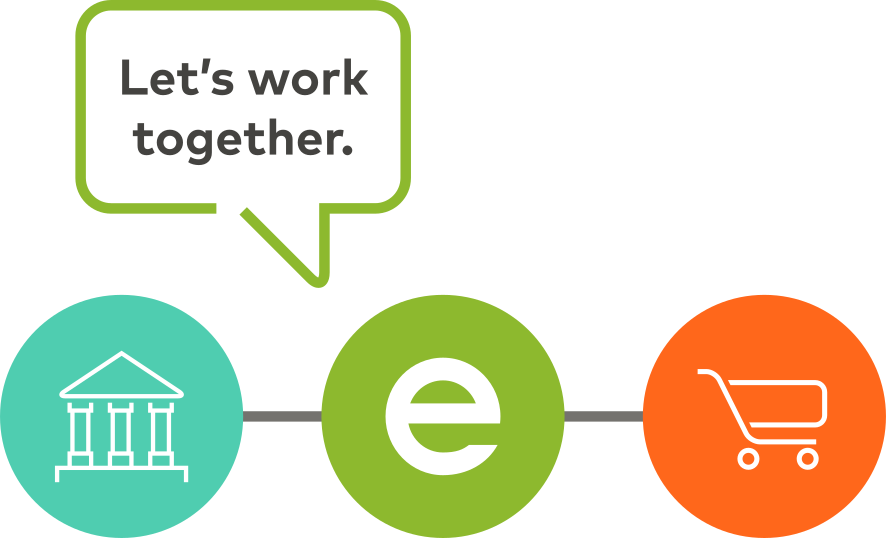
He says the reason retailers are losing the battle against cyberfraud is that the criminals are working together, selling stolen card numbers and sharing their code scripts and “best practices” for committing fraud, while the merchants work alone. Gilbert contends that if every single merchant joined together to share what they know, online fraud could be completely eliminated, and even enthusiastically encourages (even wishes for) his competitors to join the Global Fraud Fighting Community.
He tells his story in the attached video.
Posted by Andre Edelbrock on Mon, Dec 01, 2008
tekgems commented on the heels of 2checkout.com joining the Community. I know there are probably a lot of merchants wondering if there is a way to leverage other merchants’ experiences through a central database. Simple answer…there is.
Here’s the link to his post.
Watch a video of Kristin Dach, CFO of 2Checkout.com, discussing why she believes it takes a community of online merchants to work together to defeat fraud.
Click this link if you can't see the embedded video above.
Posted by Andre Edelbrock on Thu, Nov 20, 2008
Sales growth slowing…
Fresh data show that U.S. retail ecommerce grew 1% year-over-year in October, representing the sixth consecutive month this year of slowing growth rates.
The picture in the UK is not all that better as IMRG/Capgemini reported the latest figures for October show that month-on-month growth was 3.8% and year-on-year growth was 12.7% representing the lowest year-on-year growth since December 2004 – reflecting the suffering economy.
With more and more people hunkering down and less and less credit available, a turnaround to previous growth levels looks far off, and perhaps an overall decrease is in the cards.
Fraud activity on the rise… 
As Gartner security analyst Avivah Litan reports that in recent months, banking clients have been warning her of a spike in fraud, much of it based on the use of stolen financial data. “There’s been a marked increase in the number of attacks and the number of successful fraud attempts,” says Litan, due to publish a report in December. “This is the busiest my practice has ever been.”
We’ve also heard something very disturbing last week from one online businesses in that they are starting to see a rise in fraud from their good customers - commonly referred to as 1st party fraud. Good customers who are now turning to fraudulent activity in tough times by making false claims e.g., orders not being shipped or making up customer service complaints.
Shift in spend… 
Jonathan Penn, an analyst at Forrester Research, in September reported that the bulk of IT spend during the banking meltdown will go toward systems designed to keep former employees or disgruntled workers out of proprietary systems and to prevent business-killing data breaches. Often resulting in less for other areas of security.
This all adds up to…
Tough times ahead for online retailers as good customers spend less, fraud increases (now even the good customers getting in on the act!) and fraud managers being asked to do more with less. All attention shifts to the Fraud Manager. He or she is looked upon as the ultimate fighter in the battle to strike balance between revenue and fraud. He or she plays a big role in the profitability of your online business so you’d be wise to give him or her the your undivided attention.
Have a conversation…
Start by asking your Fraud Manager: “Are we doing everything possible with our available resources?”
Then ask: “What more could we do with the resources of others?”
If you get a confused look back try asking it this way: “I know they’re our competitors but what if we had Bob over at ACME, and Sue over at Bit Co. working for us on this? Would it help?” 
I’m sure you’ve heard the saying “It takes a village.”
Fraudsters realized some time ago that working in a village with other villagers made their own lives better. Going it alone isn’t enough. Why not share the pain? Why not share the cost of fraud with others for your benefit and the benefit of everyone…all at the demise of the fraudster?
Let me know what he or she says.