Posted by Andre Edelbrock on Fri, Sep 10, 2010
|

|
| Facilitated collaboration, with formally structured protocols, makes legal and ethical data sharing possible. Doing it requires a system that makes sure all the participants can benefit from one another’s transaction experiences while not passing around the data itself. |
Last week, I participated in a roundtable session on ‘data sharing’ at the Merchant Risk Council’s inaugural European e-Commerce Payments and Risk Conference in Amsterdam. It was a great opportunity to exchange insights with other industry leaders from many countries.
Data sharing is great!
Imagine if there were no restrictions on what we could share to stop fraud. Walmart and Amazon would tell each other when they caught a fraudster, what email was used, his IP location, what was attempted to be purchased, when it happened, dollar value, name, credit card number, etc. No fraudster would ever succeed at stealing more than once or twice, and we'd have good enough pattern recognition and linked data that in many cases, we'd stop them before they tried to use a compromised card, account or data the first time.
That's the real promise and power of data sharing.
But Sharing Data? Yikes!
Unfortunately, we live in the real world, and companies don't just hand each other their customer and sales data. The reality is that sharing has its limits, and it's those limits that allow so much fraud to slip through our fingers. It's the fear of what the term 'data sharing' implies that often prevents us from doing anything at all.
In our discussions with merchants, card issuers, bank, payment processors, acquirers and the like we found that 'data sharing' implies informality and lack of structure, which immediately raises concerns about privacy, security, data integrity and trust. The term also raises legal concerns about what data, if any, can be shared. This is particularly true in Europe, which has stricter controls and regulations around privacy and varies by jurisdiction. Legal authorities and governments often assume that ‘data sharing’ means that account information is simply passed around between private parties with no regard for the individual's rights.
(For more on this see discussion in FinExtra about "unauthorized access" -- which is exactly the fear that sharing conjures up, and part of the reason that the Data Protection Act exists.)
When we collaborate, we can share experiences and knowledge without sharing the data
"What", you say?! That's some fancy verbal gymnastics. But, there is much truth that if we think about data sharing and the value it can provide differently, and expand the concept to one of collaboration where independent management, structure and governance are applied, we can escape the trap that everyone thinks data sharing is a great thing in theory, but few want to subscribe to it in practice.
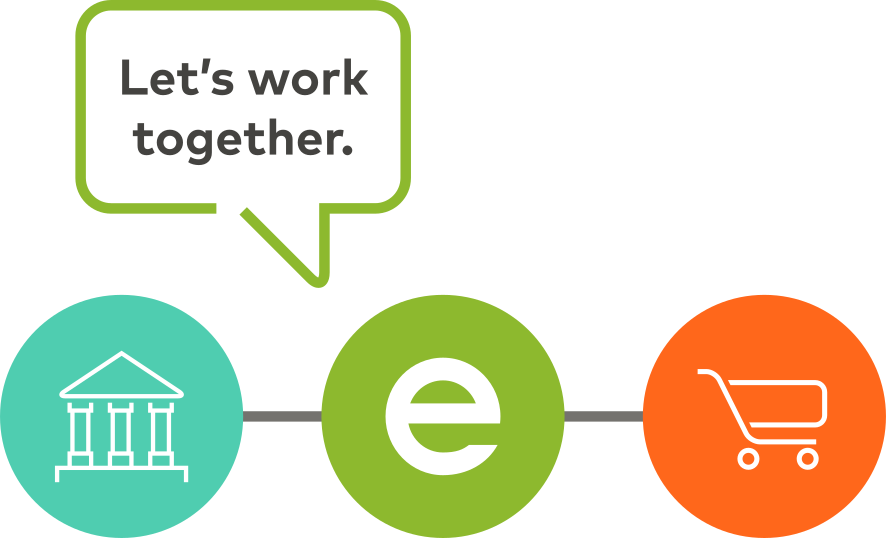
Ethoca prefers the term 'facilitated collaboration', with a full set of formally structured protocols to make legal and ethical data pooling possible. It’s a system that makes sure all the participants can benefit from one another’s transaction experiences while not passing around the data itself. That means things like the strictest conformance to PCI across all PII, highly secured access, the management, auditing and certification of data integrity by independent authorities, access to information and anonymized experiences not the data itself.
Ethoca has already proved that facilitated collaboration can work on a large scale. Our strict protocols build trust among the participants. The merchants, issuers and other stakeholders know the data can't be mined for marketing purposes or accessed for any purpose other than fraud/risk management. The information is hashed and encrypted so that even Ethoca security experts can’t see personally identifying information. Participants also get large benefits, being able to leverage one another’s payment and fraud experiences and stop ecommerce fraud that they’d never catch otherwise.
So is the difference between ‘sharing’ and ‘collaboration’ only a matter of semantics? No. As my colleague Darryl Green wrote recently, collaborative fraud prevention is the future – and trust is the key.
We'd love to hear about your experiences with data sharing. Why has it worked or not worked for you? What value would you get from facilitated collaboration versus data sharing? Please share your feedback in the comments below.
Posted by Andre Edelbrock on Mon, Nov 03, 2008
Red Flag Rules Delayed
Red Flag Rules apply to FIs and creditors with covered accounts (e.g., mortgage loans, automobile loans, credit cards). However, the broad language of the regulations has created enough uncertainty regarding their applicability to certain businesses to push the FTC to extend the compliance deadline to May 1, 2009.
Vague, Sweeping Language of Rule Leaves Many Uncertain
The unanswered question is whether it applies to oil companies, department stores, utilities, phone companies, all financial institutions of any size (from single branch community banks and credit unions on up), municipalities (water and sewage use contracts), waste management providers (many neighborhoods contract independently to have their garbage collected by their choice of company where residents sign individual contracts and hand over credit information to be approved for monthly billing), grocery stores, car dealers, appliance stores (6 months no interest layaway plans) — basically anyone who offers card credit or monthly billing or lease or store credit or a loan?
And as large a net as that casts, we wonder what about employers whose HR systems contain much of the same sensitive data. Will who has access to those systems come under scrutiny as well? And what about the ease with which those who aren’t “officially” allowed to see the data are able to view it? Any of these individuals could be singled out by identity thieves as targets for “social engineering” scams. Does that put their employer at risk for a creative ID theft lawsuit based on the regulation? — i.e. the one thing we know for sure is that the introduction of Red Flag Rules has created a sense there is open-ended risk of unknown size, with large costs for compliance and management (the same complaints that were thrown up when Sarbanes-Oxley was introduced).
Better Stewardship of Sensitive Personal Information
Regardless of the applicability of the Rules, what all these businesses have in common is that they maintain sensitive personal information that must be safeguarded. So even if you are small fry thinking the FTC isn’t targeting you, if it gets in the news that your company was part of the chain that lead to a stolen identity, you could be sued civilly and may be prosecuted legally, and you’ll lose in the court of public opinion, and in legal costs and long term reputation loss, which depending on the magnitude of the matter, could be business ending.
But back to the Rules…simply put the Rules focus on the holder of that sensitive personal information putting in place a program (and keeping it current) to ultimately prevent identity thieves from using peoples’ personally identifying information to open new accounts and misuse existing accounts. The program is to comprise three key components: identify, detect and respond to instances of identity theft.
Think like the criminal
Understand the Identity Thief
Arguably understanding the patterns of identity theft means you first need to start by thinking like the criminal. You know your data and your systems, and you should know where the vulnerabilities are. You have inside knowledge (note that most identity theft is suborned or supported by insiders), so if you were a criminal, what are the weakest points that you’d attack?
How would you the get names, SSNs, dates of birth, addresses and phone numbers stored in your systems? What social engineering techniques could you use i.e. who would you target and how would you ask for help in getting the data, and what makes him/her a likely candidate to either help directly or by being duped into helping?
What’s Your Potential Liability
Once you understand the vulnerabilities by which you can be compromised, build policies based on monitoring and disrupting the processes by which sensitive personal information can or might be accessed. Once you know how big your exposure is, you need to estimate the probability of a successful breach, and you should then allocate appropriate funds for compliance and dealing with potential losses.
And whether or not the Red Flag Rules are applicable to your company, you’d be wise to put in place a focused program to prevent and counteract identity theft…because it’s just as important for your company to avoid a loss at the hands of a stolen identity as it is for you to ensure your company is not the path to profit for identity thieves at the expense (loss) of the victim…one that may turn out to be a new or existing customer.
Related Articles